AI as an External Brain
When Your Thoughts Have 47 Browser Tabs Open

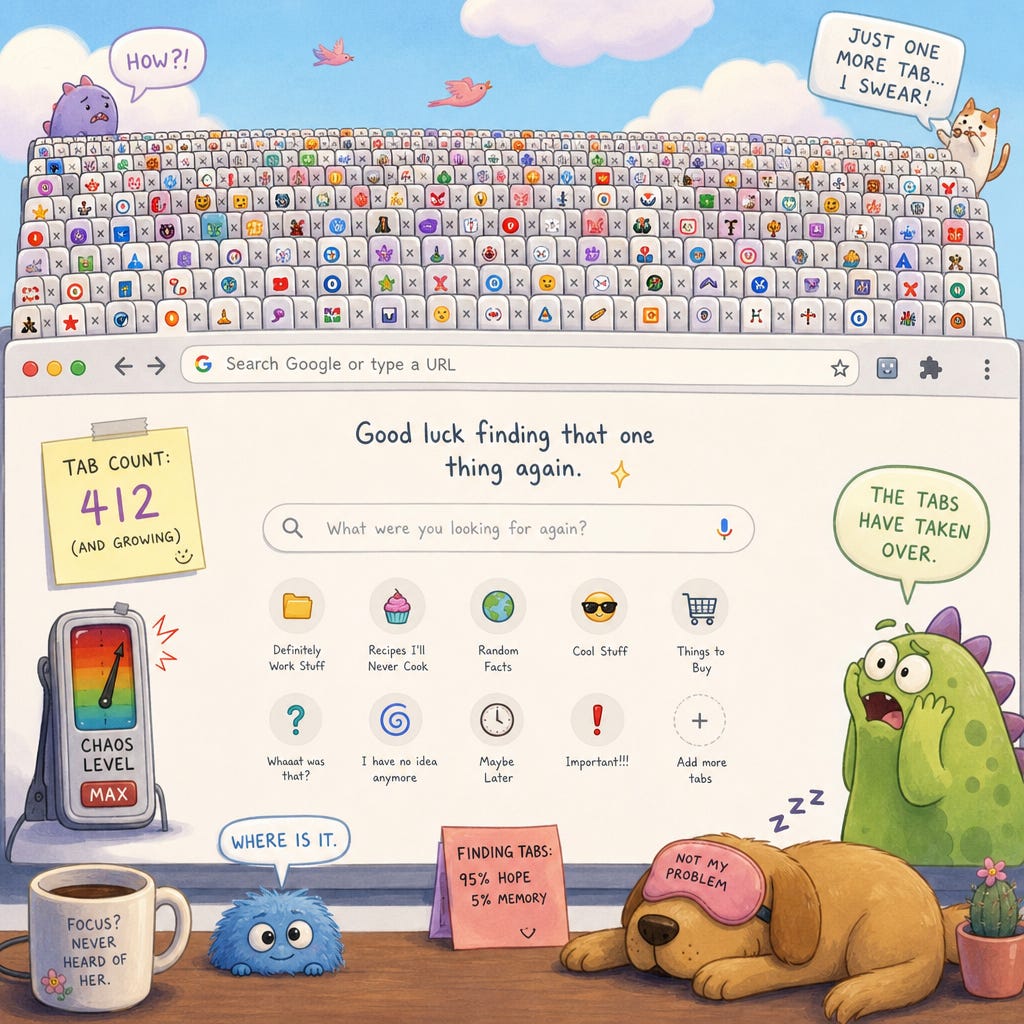
There are days when my brain feels less like a filing cabinet and more like a junk drawer that learned how to use Wi-Fi.
A client task is sitting next to a grocery reminder. A website issue is tangled up with an idea for a blog post. Somewhere in there is a dentist appointment, three half-written emails, a note about updating a service page, and the vague feeling that I forgot something important.
For some of us, this isn’t an occasional bad day. It’s Tuesday.
This is where AI has become genuinely useful to me. Not as a replacement for thinking. Not as a magic oracle. Not as some futuristic robot assistant who knows everything and never needs context.
But as an external brain.
A place to unload the pile, sort through the mess, ask better questions, and turn mental fog into something I can actually work with.
The problem is not that we are lazy
A lot of people talk about AI as if using it means you are trying to avoid effort. I do not see it that way.
Most people I know are not trying to avoid thinking. They are drowning in tiny decisions, scattered information, half-finished tasks, and the constant pressure to be organized in twelve different apps.
We have notes in our phones, emails in our inboxes, screenshots on our desktops, calendar reminders, sticky notes, voice memos, text messages, and random thoughts that arrive at deeply inconvenient moments.
AI can help gather those fragments and say, “Here is what I think you are trying to do.”
That alone can be powerful. Sometimes the most helpful thing AI does is not give you a brilliant answer. Sometimes it simply reflects your own thoughts back in a clearer order.
What I mean by “external brain”
When I say AI can act as an external brain, I do not mean giving it control of your life. I mean using it as a thinking space.
A place where you can say: “I have too much in my head. Help me sort this.” Or: “I know what I want to say, but I cannot make it come out right.”
That is a very different use case than asking AI to make decisions for you.
The goal is not to outsource your judgment. The goal is to reduce the noise so your judgment can actually show up to the meeting.
Start with a brain dump
One of the simplest ways to use AI is also one of the most effective: dump everything out.
Do not worry about structure. Do not make it pretty. Do not try to organize it first. Just write what is in your head.
For example:
I need to update my website, follow up with two clients, write a post about AI, check my email settings, schedule an appointment, figure out what to cook this week, and I keep forgetting to send that invoice. I feel scattered. Can you help me organize this into categories and tell me what to do first?
That is it.
That kind of prompt can turn a mental swarm into a list you can actually look at without wanting to walk into the woods and become a moss-covered cryptid.
AI can sort your list into categories, identify quick wins, and help you decide what needs attention today versus what can wait.
Even better, it can help you spot the thing underneath the thing. Maybe you do not actually need “get organized” as a task. Maybe you need to send one email, schedule one appointment, and move three items to next week. That is a very different emotional load.
AI is good at finding the shape of the mess
Paste in notes from a meeting. AI can help pull out decisions made, questions still open, tasks assigned, and follow-up items needed, while giving you a first pass instead of five pages of notes and no idea where to begin.
You still review the result. You still make sure it understood the situation. But sometimes a first pass is the difference between “I will deal with this later” and “I can handle this in twenty minutes.”
It can also help with emotional friction
One of the underrated uses of AI is helping with tasks that are not technically difficult but feel weirdly hard to start.
Writing a polite follow-up email. Responding to someone after too much time has passed. Asking for clarification. Setting a boundary. Saying no.
These tasks can sit in your mind for days because they carry emotional static. AI can help remove some of that static by giving you a draft.
You may not use it exactly as written. In fact, you probably should not. But now you are not starting from a blank page. You have clay on the table. That matters.
Use it to ask better questions
AI is also helpful when you are trying to understand something that feels too technical, too legal, too medical, or too full of tiny print.
Ask it: Explain this in plain English. What are the main points? What questions should I ask before I make a decision?
That last part is important. The best use of AI in these situations is not “Tell me what to do.” It is “Help me understand what I should ask.”
That keeps the human in charge. AI can help you prepare for a doctor’s appointment, a contractor meeting, a client call, or a legal conversation. It can help you walk into the room with better questions and a clearer sense of what you do not understand yet. That is not weakness. That is preparation.
The external brain still needs supervision
AI can be confidently wrong. It can misunderstand your context, make assumptions, and sound polished while being incorrect.
So do not treat it as truth. Treat it as a thinking partner. Let it organize, summarize, brainstorm, rewrite, simplify, and reflect. Then bring your own judgment back into the room.
For anything important such as medical, legal, financial, security, and business decisions you need to always verify the facts. Use AI to help you understand the landscape, not to replace the expert.
A simple way to try this today
Here is a prompt you can copy and use:
I am going to brain dump everything that is currently on my mind. Please organize it into categories, identify anything urgent, suggest the first three next steps, and point out anything that may need clarification. Do not overcomplicate it.
Then paste the mess. That is the whole trick.
You do not need a fancy system. You do not need a perfect productivity method. You just need a place to put the mental pile so you can look at it from the outside.
The real benefit
For me, the real magic of AI is not that it makes me faster, though sometimes it does.
It is that it helps me get unstuck.
It turns “I cannot even start” into “Here is the first step.”
It turns “I have too much in my head” into “Here are the pieces.”
It turns “I know what I mean but cannot explain it” into “Here is a draft you can shape.”
That is why I think “external brain” is one of the most practical, human uses of AI. Not because we need machines to think for us. Because sometimes we need help clearing enough space to hear ourselves think.